

Hums but Will Not Grind
Power is reaching the motor but the flywheel is stuck. Almost always a jam; the full method is in the jammed section.
It hums. It leaks. It quit the night of a big family dinner. The garbage disposal is the smallest appliance on this site and the one most likely to be misjudged, replaced when it only needed unjamming, or kept dripping when its seals were done. Disposal repair in Burleson sorts the two honestly, across 76028 and 76097.
Call (619) 826-9631 for garbage disposal repair anywhere in Burleson, TX. Disposals that hum without grinding, trip their reset, leak from the flange or the base, or sit completely dead are assessed in the home across ZIP codes 76028 and 76097. Two things first: if it hums, switch it off, and whatever has happened, never put your hand into the disposal chamber.
Disposals have the shortest fault list on this site and the clearest repair-or-replace line. The sections below follow the hum, the leak and the dead unit in turn.
Four complaints account for nearly every disposal call. Each one has its own first check you can do safely.
Power is reaching the motor but the flywheel is stuck. Almost always a jam; the full method is in the jammed section.
No hum, no movement, nothing. Reset button, switch, breaker, then motor, in that order; see not working.
Top, side or bottom: the location decides whether this is a reseal or a replacement. See the leaking section.
Worn impellers and grind plates push food through half-processed, and the sink drain beyond pays for it in slow clogs.
The overload protector reporting a motor that runs hot on ordinary loads: the clearest end-of-life signal a disposal gives.
Disposal and dishwasher share plumbing. A new disposal with its plug left in stops the dishwasher draining entirely.
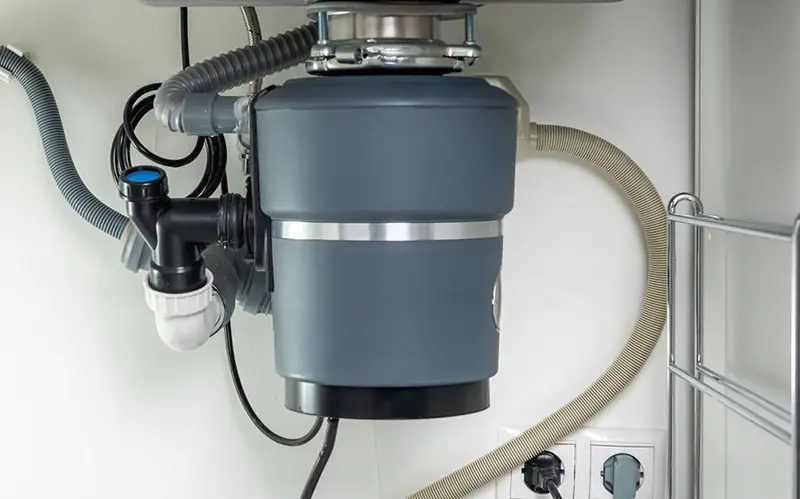
A disposal does not have blades, which surprises most owners. It has a spinning flywheel with loose impellers that fling food against a stationary grind ring, shredding it by centrifugal force and friction. A jam happens when something wedges between the flywheel and that ring: the classic finds are bottle caps, coins, cherry and olive stones, small bones, a dropped fork or spoon ground part-way, and the glass shard nobody knew fell in. The motor strains against the wedge, produces the famous hum, heats up, and within a minute or so the overload protector cuts it off to save it.
Rule one, stated without qualification: a humming disposal gets switched off immediately, and it is never, ever cleared by hand from above. Fingers do not belong in the chamber even with the power off, because a jam under tension can release suddenly. The safe clearing route is from below: most disposals have a hex socket in the centre of the underside. With the switch off, a hex wrench in that socket works the flywheel back and forth by hand until the obstruction frees, then long tongs or needle-nose pliers from above remove it. Many Burleson owners have done this at least once; if it does not free with moderate force, stop there rather than leaning on it.
After a jam clears, press the reset button on the underside if the overload tripped, run cold water, and switch on. A healthy unit spins up cleanly. Three outcomes mean more than a jam: the unit hums again with an empty chamber, which suggests a seized bearing or motor damage; it runs but grinds weakly and loudly, suggesting damaged impellers or ring; or it trips the reset again quickly, reporting a motor that overheats under no real load.
Repeat jams on soft food are not bad luck; they are wear. Impellers round off and the ring dulls over years of service, so food wedges instead of shredding. If your disposal jams on things it used to eat, that trajectory is worth describing on the call to (619) 826-9631, because it changes the advice from clearing to planning a replacement on your schedule instead of the unit’s.
Under-sink leaks soak quietly into cabinet floors, so find the highest wet point; water only runs down. A leak at the very top, where the disposal meets the sink, is the sink flange seal: the putty or gasket between flange and sink has aged, or the mounting has loosened until the seal gaps when the unit vibrates. That one is a genuine repair, reseating and resealing the flange, and catching it early saves the cabinet base.
A leak at the side is a connection, not the unit: the dishwasher drain hose joins the disposal at a side inlet, and its clamp loosens or the hose perishes; the main discharge pipe connection below it does the same. Both are joint repairs. Note whether the drip keeps time with the dishwasher draining, which confirms the inlet side in one observation.
A leak from the bottom of the unit is the verdict leak. The disposal’s internal seals keep water in the grind chamber and out of the motor housing below it; when they fail with age and corrosion, water tracks through the motor and drips from the base or the reset button area. There is no seal kit that redeems that design economically, and a unit wetting its own motor is also an electrical concern. Bottom leak means replacement, plainly, and the honest service is saying so quickly rather than resealing everything above it in hope.
While any leak is active, dry the cabinet floor, put a tray or old towel under the unit, and keep stored chemicals and paper goods out of the wet zone. Then call (619) 826-9631 and report the highest wet point, top, side or bottom; that single detail sets the whole visit’s expectation. If the dishwasher has been draining oddly at the same time, mention it, because the two share this plumbing.
A completely dead disposal, no hum, no movement, is usually one of four things, and three of them cost nothing to check. First, the overload reset: the small button on the underside trips whenever the unit jams or overheats, and until it is pressed back in, after the unit cools, the disposal is electrically dead by design. Second, the switch and supply: disposals are often on a switched outlet under the sink, and plugs work loose in a crowded cabinet; if yours is hardwired, the switch itself is the suspect. Third, the breaker, since the disposal and dishwasher frequently share a circuit that can trip without ceremony.
Fourth, and only after the free three, the motor. Motors die from age, from corrosion after long seal leaks, and from being run stalled and humming until the windings cook. A motor-dead disposal that once leaked at the base tells a single coherent story.
If the checks revive it, observe what it does next: a unit that trips again on the next ordinary use has told you its motor is weak, whatever the reset says. If the checks do not revive it, the conversation is replacement, and the useful questions become practical ones about matching the mounting and connections already under your sink, so the swap is clean.
One more dead-disposal scenario specific to remodels: a newly fitted disposal that has never run sometimes has its shipping restraint or wiring configuration missed, and a newly fitted unit that will not let the dishwasher drain has the famous knockout plug still in its inlet, covered on the dishwasher page. Tell the call if the unit is new; new-unit faults are installation faults until proven otherwise. Call (619) 826-9631 once the free checks are done.
Disposal work is quick but methodical, and it happens with the power safely off and the cabinet floor protected.
Power isolated, the chamber is lit and inspected with tools only, the flywheel is worked from the hex socket below, and the obstruction or wear is identified without a hand ever entering the unit.
Flange, dishwasher inlet, discharge joint and the unit’s base are checked dry and then under running water and a running dishwasher drain, so a leak is located at its highest point, not its puddle.
Jams are cleared and the unit load-tested with water and scraps; resealable leaks are resealed. If the seals or motor have failed, you hear that it is a replacement, with the reasons, before any money moves.
Continuous-feed disposals from InSinkErator, the brand under most Burleson sinks, plus Waste King, Moen, GE, KitchenAid and Frigidaire units, in the common half and three-quarter horsepower sizes. Batch-feed models with their stopper switches are covered too. Septic-aware models matter in the fringe of the city where homes run septic systems, and that is worth mentioning on the call if your home is one of them.
No page on this site has a cleaner line. Repair: jams, resets, flange reseals, hose and joint leaks, switch and supply faults. Replace: bottom leaks from failed internal seals, burned or seized motors, reset trips that return under light use, and grind components worn smooth. A disposal is also the least expensive appliance in the kitchen, so the labour of deep internal repair rarely survives arithmetic; the repair or replace guide explains the general rule this page applies.
Burleson disposals meet Burleson cooking: brisket trimmings and barbecue weekends, crawfish boils in season, sweet corn husks in summer and holiday cooking marathons that push a week of scraps through in a day. The faults cluster after gatherings, which is when a borderline unit picks its moment.
Landlords know this appliance well too: disposals are the most tenant-abused unit in a rental kitchen, and a call that establishes jam versus failure saves everyone an argument. From Old Town to Chisholm Summit, in 76028 and 76097, the under-sink service runs on the same single number.
See the full service area →The disposal’s under-sink partner and kitchen neighbours:
Dishwasher repair in BurlesonThe motor has power but the flywheel cannot turn: something is jammed between the flywheel and the grind ring. Bottle caps, bones, a piece of cutlery or a stone from produce are the usual finds. Switch it off and leave it off while it hums; a stalled motor overheats and trips its overload. Never reach into the chamber with your hand, ever. Many jams clear safely with the hex wrench socket under the unit, turning the flywheel by hand from below.
Work through the free checks in order. The overload protector trips when the unit jams or overheats: wait for it to cool, then press the small reset button on the underside. Next, the wall switch and the plug or wiring under the sink. Then the breaker, since disposals often share a circuit that trips quietly. If all four are innocent and the unit is still dead, the motor itself has likely failed.
Leak location is the diagnosis. Water at the top, around the sink flange, is a sealing problem: putty or the flange gasket has given up, often repairable by reseating and resealing. Water at the side connection is the dishwasher hose or discharge pipe joint. Water dripping from the bottom of the unit is the serious one: it means the internal seals have failed and water is passing through the motor housing, which is not repairable. A bottom leak means replacement; do not let it keep wetting the cabinet floor.
Most jams are fixed in minutes once the obstruction is found and removed and the flywheel turns freely again; the jam itself does not damage a healthy unit if it was switched off promptly. The exceptions are a jam that has burned the motor through repeated humming attempts, and impellers or grind components worn or broken by whatever went down. Expect a straight answer after the first look under the sink.
A reset that trips occasionally after a jam is doing its job. One that trips repeatedly, on ordinary soft scraps, is reporting a motor running hot and weak, or bearings dragging as the unit wears out. Combined with slow grinding, loud operation or a unit that needs a rest between uses, repeat tripping is the clearest sign a disposal is at the end of its working life.
Cooking grease and oils, which coat the unit and the pipes beyond it; coffee grounds in quantity, which settle like sand; starchy expanders like pasta and rice; fibrous skins and strings, which wrap the impellers; and anything hard enough to chip or jam, from fruit stones to shell and bone beyond small scraps. Cold water while grinding, and a few seconds of water after, keeps what does go down moving. When in doubt, the trash can is the safer appliance.
Call now, say whether it hums, leaks or sits dead, and get a straight fix-or-replace answer.
Call (619) 826-9631